
Quick answer: A risk register for a capital project is a living record of every identified risk, scored for likelihood and impact, grouped by risk category, and paired with a response strategy and mitigation action. The fastest, most reliable way to build one is to start from standardized risk checklists that capture corporate knowledge, then use those checklists to populate the register inside a Project Management Information System (PMIS) rather than a spreadsheet.
Regardless of an organization's role in delivering a capital project, checklists are one of the most proven methods for identifying project risks. Risks captured on the checklist are compiled into a risk register, then analyzed, prioritized, and matched to response plans. Comprehensive, detailed risk checklists are how a capital project team captures corporate knowledge and stops re-learning the same lessons on every project.
What is a risk register for a capital project?
A risk register is the central document that lists all identified project risks and, for each one, records its category, the pre-mitigation likelihood and impact, the chosen risk response strategy, the mitigation action, and the post-mitigation likelihood and impact. On capital projects, where budgets are large and delivery can span years, the register becomes the single source of truth for qualitative risk analysis and the basis for the project risk dashboard.
Why start the risk register with checklists?
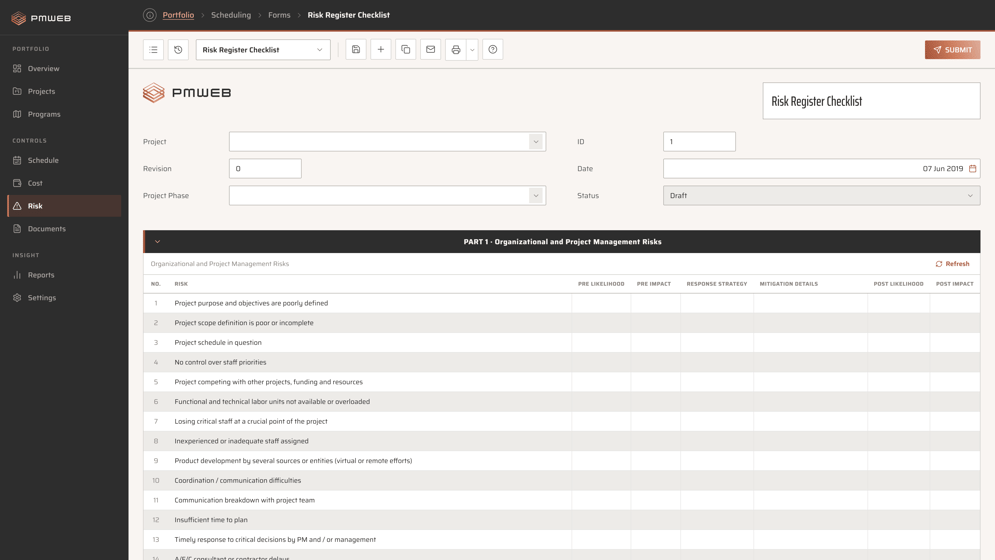
Checklists formalize the qualitative risk analysis process. Using a PMIS like PMWEB, organizations turn a comprehensive risk checklist into the risk register needed to manage all project types, and capital projects in particular. The PMWEB custom form builder creates a checklist that covers every risk category. The form header captures the project, the project phase the analysis covers, the checklist status (set by the assigned workflow), and any other general information the checklist needs.
The risk categories every capital project checklist should cover
What matters most is capturing the possible risks within each risk category. A comprehensive capital project risk checklist should span:
- Organizational and project management risks
- Contract acquisition risks
- Technical risks
- Lands and damages
- Regulatory and environmental risks
- Construction risks
- Estimate and schedule risks
- External risks
How to score likelihood and impact for each risk
For each risk in a category, the checklist captures the pre-mitigation likelihood and impact scores, the proposed risk response strategy, the details of the mitigation action to be implemented, and the post-mitigation likelihood and impact scores. Likelihood and impact use a predefined scale from 0 to 5. A score of 0 means the risk is not applicable to the current project or phase; scores of 1 to 5 rate the chance of occurrence and the severity of impact, where 1 is very low probability or impact and 5 is very high.
Attach the evidence behind the analysis
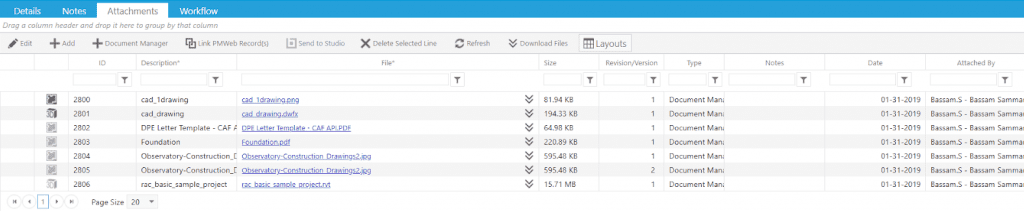
The attachment tab stores every document used to perform the qualitative risk analysis and produce the project risk register. It can also link to other PMWEB records, such as the project budget, project schedule, and risk review meeting notes, so the reasoning behind each score stays traceable.
Assign a workflow for review and approval
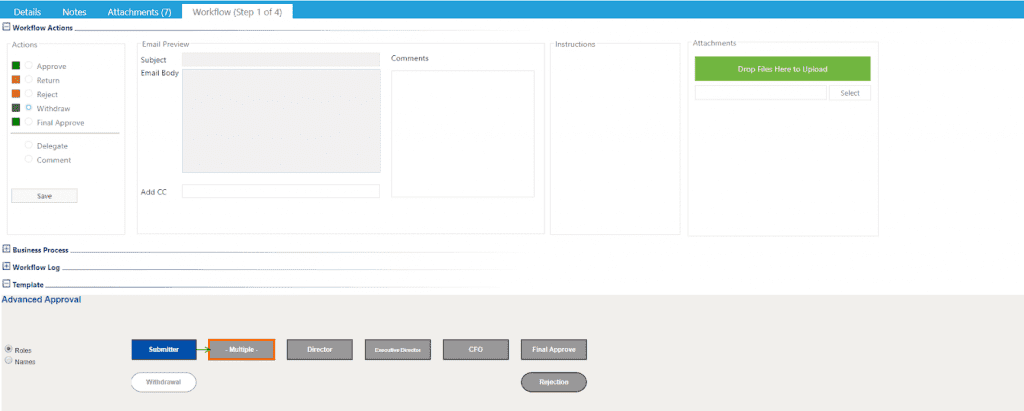
A workflow is assigned to the risk checklist form because different team members may perform the qualitative risk analysis for each risk category, and others may be responsible for reviewing, approving, and giving final approval to the completed analysis. The workflow makes those responsibilities explicit and auditable.
Control who can edit each risk category
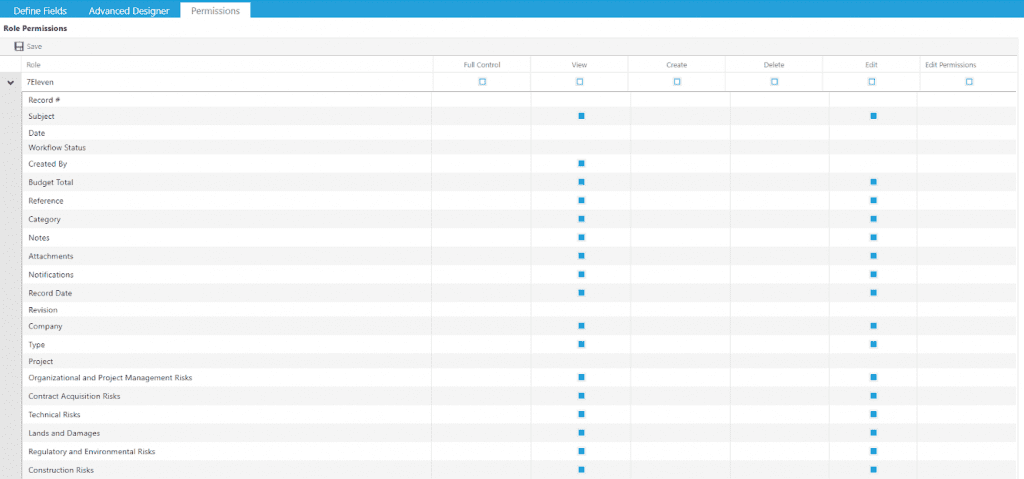
The PMWEB custom form builder assigns edit and view permissions to the risk tables, with each risk category captured in its own table. Separating categories this way lets the organization continuously improve and expand the list of risks identified for each category over time, so the checklist grows more comprehensive with every project.
Turn the checklist into a risk register and dashboard
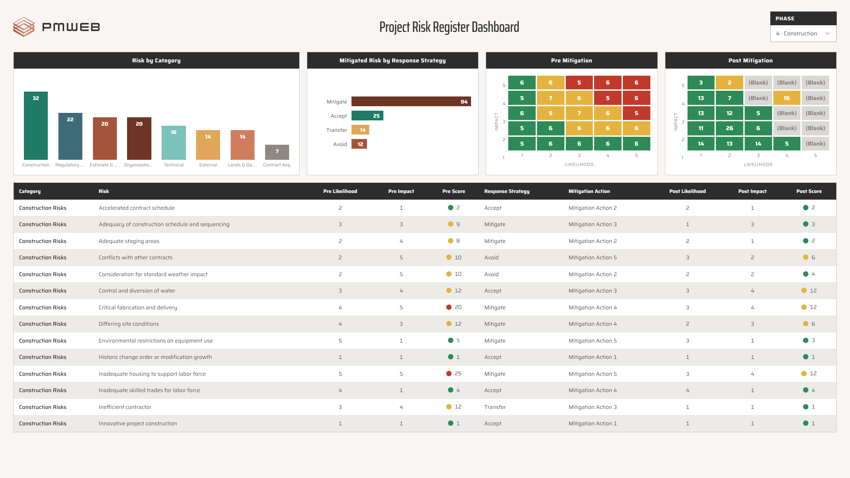
The data captured in the checklists becomes the basis for the project risk register and dashboard. The register table details all identified risks grouped by category, with pre-mitigation and post-mitigation likelihood, impact, and score, plus the selected risk response strategy and the mitigation action. The dashboard adds two visuals that group risks by category and by response strategy, and both can be used to filter the tabular register.
The report also includes the risk likelihood and impact heat map matrix: one view shows the count of risks in each cell before mitigation, and a second shows the count after mitigation. Other report and dashboard layouts can be designed to work across a single project or a portfolio, and within a single project life cycle phase or across phases.
The bottom line
Checklists are what make a capital project risk register comprehensive rather than ad hoc. They capture corporate knowledge, standardize scoring, and feed a register and dashboard that leaders can actually act on. Managing that process in a PMIS, instead of scattered spreadsheets, keeps the analysis connected to the budget, schedule, and change records that risks eventually touch. For more on moving risk off spreadsheets, see how digital transformation enables proactive project risk management and reporting, and how integrating AI, risk, and change management keeps that data reliable.
Want the full method? Download the Risk Forecasting Guide for Capital Project Teams to see how to build a structured, checklist-driven risk register, or request a demo to walk through PMWEB's risk analysis module with our team.
Frequently asked questions
What is a risk register in project management?
A risk register is a document that lists all identified project risks and records, for each risk, its category, likelihood, impact, risk score, response strategy, mitigation action, and owner. It is created during qualitative risk analysis and updated throughout the project life cycle.
What should a capital project risk register include?
A capital project risk register should include each risk's category, a pre-mitigation likelihood and impact score, the proposed response strategy, the mitigation action, and a post-mitigation likelihood and impact score. Grouping risks by category and adding a heat map matrix makes the register easier to prioritize.
How do risk checklists help build a risk register?
Risk checklists standardize the risks a team looks for in each category, so nothing is missed and corporate knowledge carries from one project to the next. The completed checklist populates the risk register directly, turning qualitative analysis into a structured, reportable record.
What are the main risk categories for capital projects?
Common categories are organizational and project management risks, contract acquisition risks, technical risks, lands and damages, regulatory and environmental risks, construction risks, estimate and schedule risks, and external risks.
How is likelihood and impact scored on a risk register?
A common approach uses a 0 to 5 scale. A score of 0 means the risk does not apply to the current project or phase, while 1 to 5 rate the probability of occurrence and the severity of impact, with 1 being very low and 5 being very high. Scoring both before and after mitigation shows the effect of the response plan.